
Air Bar vs. Duck Foot Paddle Tines: What’s the Real Difference?
If you’ve been growing pulses or soybeans for any length of time, you’ve probably heard about air bars. Maybe your dealer brought it up. Maybe you drove past a field and noticed the manifold sitting out front of a neighbour’s header. Or maybe you saw it pop up on social media. Either way, it’s a common aftermarket solutions farmers use when header loss starts costing them bushels, which we know turns into dollars.
What some people don’t know is that Duck Foot® paddle tines solve the same problem. But they go about it in a completely different way, and for a lot of farming operations, the difference matters more than people realize.
Let’s break down what each option is, how they work, and which might be the best solution for you.
What is an air bar?
An air bar is an attachment that mounts out front of your existing reel. It stays alongside your factory reel, not instead of it (the most well-known brand being the AWS Airbar, made in Mitchell, Ontario). A belt-driven fan, powered off the right side of the combine feeder house, pushes high-velocity air through a manifold and down through nozzles pointed at the cutter bar. That air, which is coming out at around 200 mph, blasts loose pods and material off the knife and pushes them back toward the auger or draper belt and into the feederhouse, rather than letting them fall to the ground.
The idea is straightforward. Short, low-lying pods in lentils, soybeans, and peas are often sitting right at the knife when the header passes over them. Without some help, a good chunk of that crop hits the ground instead of the hopper. An air bar is designed to fix that with a continuous curtain of air.
What about the Air Reel?
You may have also heard of the Crary Air Reel – and it’s worth clarifying the difference, because the two get mixed up often. The Air Reel is a trademarked product from Crary Industries out of Valley City, North Dakota. Unlike an air bar, the Air Reel is a complete reel replacement. You remove your factory reel entirely and swap in the Crary system, which pipes air through the center tube of the reel itself, directing it down toward the cutter bar through drop tubes. The fan is PTO-driven off the feederhouse and the whole unit replaces what came on your header from the factory.
The Air Reel has a loyal following, particularly in short bean and lentil country, and it does what it claims. But it’s a significantly larger investment with new units running from $23,700 CAD (or $17,000 USD) and up depending on header width. It also comes with more maintenance than an air bar, including gearbox wear and periodic drive component attention. Farmers who run one tend to commit to it for that specific header.
So, while both the Air Reel and an air bar use the same basic principle -move crop off the knife with air – they’re different systems at different price points, and they install and operate very differently. The air bar is the more accessible entry point into air-assist harvesting for most operations.
Where Duck Foot paddle tines come in.
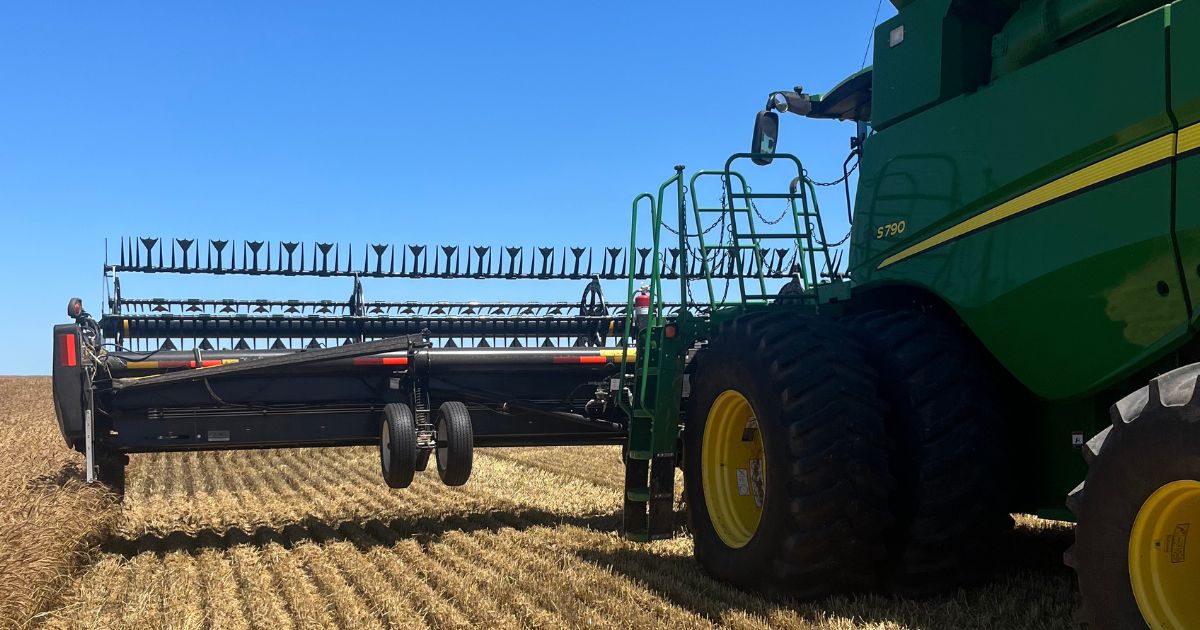
Duck Foot® paddle tines take a different approach altogether. Instead of adding a fan and air system to the front of your header, they clip directly over your existing reel tines using a secure clip system that attaches to the reel pipe. No replacing the reel. No adding a drive system. No removing parts of your header to install them. These patented paddle tines expand the surface area of each tine by up to 47%, giving the reel more controlled, consistent contact with the crop which moves it more gently and more efficiently into the header.
One of the biggest practical benefits is that with Duck Foot® tines on, you can run a slower reel speed. That slower reel reduces the aggressive raking action that causes shatter, allows for smoother more consistent feeding of the machine, and the paddles compensate by moving more crop per rotation. Farmers consistently report cutting header loss by up to 75% and being able to push ground speed up by as much as 20%.
How they compare in the field
Both systems produce real results. An air bar works well in short pulses and soybeans; it keeps the knife clear and pushes loose material into the feederhouse instead of onto the ground. AWS claims 1 to 4 bushels per acre improvement in those conditions, and that lines up with what farmers report when conditions suit it.
But there are situations where an air bar runs into trouble. At night, the system kicks up a significant amount of dust that cuts visibility considerably. In taller or heavier soybean crops, the air can blow leaf material back onto the drum and restrict airflow, and in those conditions, farmers often turn the system off entirely. Switching between crops can also be a hassle; removing the air bar when moving to wheat or taller cereals typically takes two people and increases downtime.
Duck Foot® tines don’t have those constraints. While providing similar bushel per acre results as the air bar and reel, Duck Foot® paddle tines work across a much wider range of crops — lentils, soybeans, chickpeas, peas, wheat, canola, barley, flax, sorghum, and more — without any adjustments. There’s no fan running, no air to manage, and no reason to remove them between crops. In lodged or down crops especially, the paddles do something air simply can’t: they physically lift and guide the material into the header rather than blowing past it. The paddle tines paired with slower reel speed creates a smooth and consistent flow of crop into the combine which means it feeds much easier with minimal bunching, whereas the air systems only help the crop clear the cutter bar and don’t assist in smoother feeding.
|
|
Air Bar |
Crary Air Reel |
Duck Foot Paddle Tines |
|
Cost & Setup |
$25,000 + $3,400 install; 2-person job to install or remove between crops; Belt and fan need seasonal attention |
$23,000 and up + install; significant install time; Gearbox, sprockets, seals; rebuilds at $900+ |
Pricing varies depending on the size of the header. A 40’ 6 batt header starts at $4,300; installs in minutes – less than 1 hr to complete installation with 2 people, no tools |
|
Crop Range |
Best in short lentils, soybeans, peas
|
Best in short lentils, soybeans, peas |
Good in all crops and conditions – lentils, peas, soybeans, wheat, canola, barley, flax, and more |
|
Down Crop |
No advantage |
No advantage |
Helps pick up and feed the crop more smoothly, reduces wad feeding |
|
Field Performance |
1–4 bu/ac improvement in pulse and soy Moderate ground speed gains in suitable crops |
1–4 bu/ac improvement in pulse and soy Moderate ground speed gains in suitable crops |
Up to 75% header loss reduction Up to 20% ground speed increase |
|
Night Harvest |
Air kicks up dust, cutting visibility after dark |
Same dust problem after dark |
No dust — no air system running |
The practical side: cost, install, and maintenance
An air bar system is an investment. New units are header and combine specific, meaning you need the right fit for your setup. Used units on AgDealer are currently listing anywhere from $7,000 to over $20,000 CAD depending on width and model. The system also adds a drive belt and fan assembly that need to be monitored and maintained throughout the season.
Duck Foot® paddle tines install in minutes. No tools, no dealer visit, no drive system to manage. A full set covers all five or six batt reels on your header, and once they’re on, there’s virtually nothing to maintain.
Why Duck Foot comes out ahead
Air bars do what they’re designed to do, and they’ve earned a following for a reason, particularly in straight bean and lentil country where short crops and clean fields are the norm. But they’re a specialized solution. They’re at their best in specific crops under specific conditions, and outside of those conditions, a lot of farmers end up working around them.
Duck Foot® paddle tines were designed by a Saskatchewan farmer who got tired of watching crop hit the ground during harvest. They work in the conditions farmers actually face – mixed crop rotations, lodged cereals, pulses, straight-cut canola, all without adding a drive system, without creating a dust cloud, and without requiring a tool kit to swap between crops. The improvement is mechanical and consistent, regardless of what’s in the field.
Farmers who put them on rarely to take them off. That’s probably the most straightforward endorsement there is. Here’s what some of our customers have said about the comparison and what they noticed on their farm:
“I absolutely love my duck feet. Comparing an air reel to duck feet. These pick up short navy beans and consistently feed them better. Less header loss than an air reel. Can travel .3-.4 mph faster. An air reel impedes crop flow in large growthy soybeans, and duck feet just make the header feed better. No need to remove, unlike an air reel in canola or thick wheat. No extra dust or sand blowing into and wearing out the combine either. I’d never go back to an air reel. Very reasonable priced and easy to install.”
Darryl B., Mt. Bridges, ON Tweet
"They are working great. Might actually have more header loss with my air bar as compared to the header with DFP. Amazing product."
Jason H., Snowflake, MB Tweet
If you want to see the difference for yourself, contact your local Duck Foot Parts dealer or reach out to us through our Contact Us page. We’re happy to help you find the right fit for your header and help you increase your harvest efficiency.