
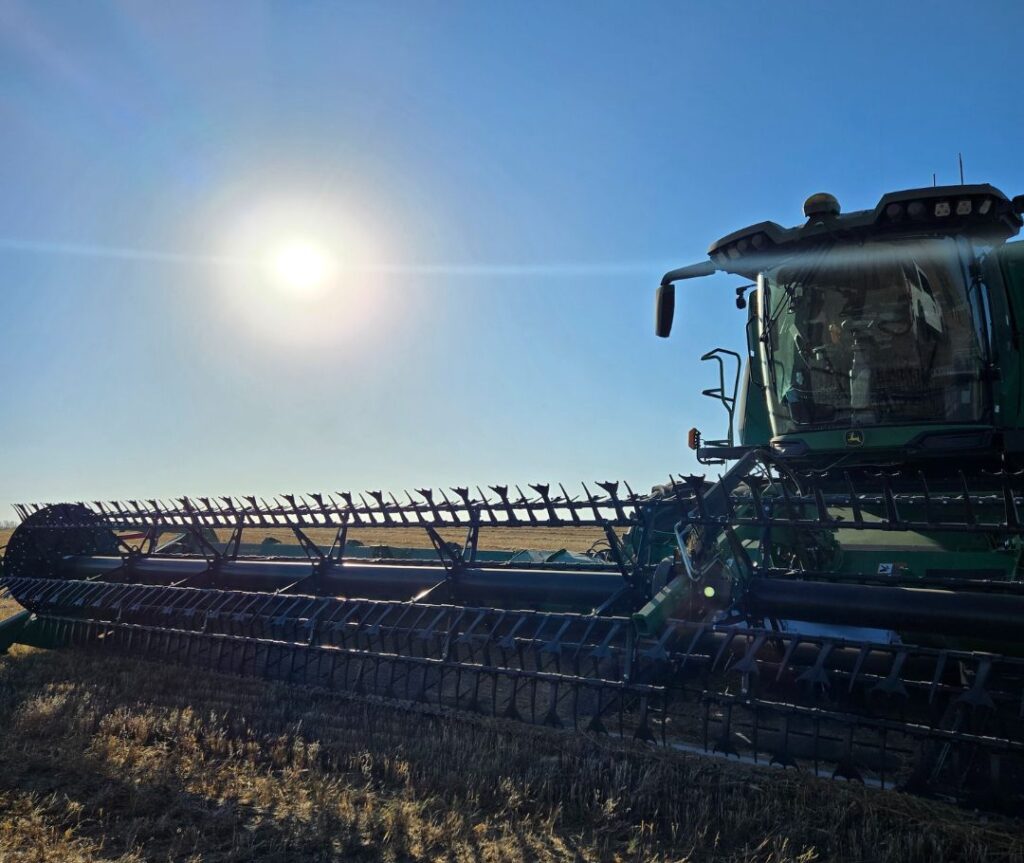
During harvest 2025, Steve had the opportunity to do in-field testing using drop pans to compare the header loss on MacDon FD245’s in barley. Testing with drop pans provides us with a clear and measurable way to show the difference between headers with and without the Duck Foot® paddle tines. This crop was average for Saskatchewan, and testing was done on a dry hot day which made for dusty conditions (as seen in the video).
How In-Field Testing is Done
Steve used the drop pans in 3 different areas of the field where two machines were harvesting side by side – one combine had Duck Foot® paddle tines and the other did not. As the machine is running, the drop pan is set out to capture the losses from the header. The pan is then lifted, and the barley heads underneath are counted which gives an undeniable measure of exactly what is being lost. The machine with duck feet had the reel pitch adjusted to the least aggressive setting, and the reel speed slowed as we recommend in our Installation Videos. The machine without duck feet used the standard factory settings recommended by MacDon.
The Findings
| Test Section | Loss without DF | Loss with DF | % Improvement | $ Saved |
| 1 | 19 heads | 0 | 100% | (19 x .5) * 5 = $47.5/acre |
| 2 | 20 heads | 2 heads | 90% | ((20-2) x .5) * 5 = $45/acre |
| 3 | 19 heads | 1 head | 94% | ((19-1) x .5) * 5= $45/acre |
Supporting Data:
- 1 head of barley = .5 bu
- Average barley price/bu in 2025/2026 = $5.00/bu
In addition to reducing header loss, the machine with Duck Foot paddle tines had increased ground speed of 0.5 mph, leading to reduced harvest time and operating costs.
Overall, adding Duck Foot tines reduced header loss by an average of 94% and had the potential to increase the harvest profits by up to $7,000 in a 160-acre field.
Contact your local Duck Foot Parts dealer to order yours and improve your harvest efficiency.